





Sizing Off-Grid Inverters: Calculate Load, Battery & Solar Needs
- Why Proper Sizing Matters for Off-Grid Systems
- Energy independence, reliability and user experience
- Cost optimization and lifecycle considerations
- Safety, standards and approvals
- Step-by-Step Sizing: Calculate Your Load, Inverter, Battery & Solar Needs
- 1) Inventory appliances and calculate daily energy (Wh)
- 2) Inverter sizing: continuous rating, surge and waveform
- 3) Battery capacity: usable Ah, DoD, efficiency and autonomy days
- Choosing the Right Inverter and Battery Chemistry
- Pure sine vs modified sine: performance and compatibility
- Battery chemistries: lead-acid vs lithium (LiFePO4 and others)
- Inverter features and integration
- Real-World Example and Component Selection
- Sample load inventory and calculation
- Sizing the inverter
- Battery bank sizing (example)
- Sizing the solar array
- Testing, commissioning and maintenance
- Manufacturer Guidance and How Guangzhou Congsin Helps
- Product fit for off grid inverter systems
- Production quality, certifications and customization
- Product strengths and applications
- Practical Tips, Sources and Final Checklist
- Practical tips for reliable performance
- Quick pre-install checklist
- Data and standards references
- FAQ — Sizing Off-Grid Inverters (Common Questions)
- 1. How big should my off grid inverter be relative to my total load?
- 2. How many days of battery autonomy do I need?
- 3. Should I use 12V, 24V or 48V system voltage?
- 4. Can I use a modified sine wave inverter for an off-grid home?
- 5. How do I account for inverter and battery efficiency in sizing?
- 6. How much solar should I install if my location has low sun hours?
- Contact & Next Steps
Accurate sizing of an off grid inverter system is the foundation of a reliable, efficient off-grid installation. This guide walks you through a field-proven, engineering-based method to calculate appliance loads (Wh), select an inverter with correct continuous and surge ratings, design a battery bank with appropriate ampere-hours and depth-of-discharge (DoD), and size the solar array to meet daily energy needs. Data and methods reference authoritative sources such as Wikipedia's inverter overview and U.S. federal renewable-energy guidance to ensure claims are verifiable. Learn practical formulas, sample calculations, equipment selection criteria, and how a qualified manufacturer like Guangzhou Congsin can supply optimized DC→AC inverters, solar charge controllers and portable stations for your project.
Why Proper Sizing Matters for Off-Grid Systems
Energy independence, reliability and user experience
Under-sizing any component—especially the inverter—creates nuisance tripping, overloads and shortened equipment life. Oversizing increases cost and reduces system efficiency. Properly sized systems deliver predictable run-times for appliances, consistent voltage and better battery health. For reference on inverter roles and operation, see the inverter overview on Wikipedia: https://en.wikipedia.org/wiki/Inverter_(electrical).
Cost optimization and lifecycle considerations
In off-grid systems the largest lifecycle costs are batteries and energy shortfalls (requiring backup or generator runtime). A battery bank sized with the correct usable capacity (accounting for DoD and inverter efficiency) reduces generator runtime and extends battery life. Use proven calculations to balance capital expense and operational cost.
Safety, standards and approvals
Sources such as IEC standards and national electrical rules guide safe installation practices; choose inverters and charge controllers with recognized approvals (CE, EMC, LVD, ETL) to meet local requirements. Manufacturers that publish conformity and testing details make compliance and permitting easier.
Step-by-Step Sizing: Calculate Your Load, Inverter, Battery & Solar Needs
1) Inventory appliances and calculate daily energy (Wh)
Create a detailed list of every load in watts and expected daily run hours. For each appliance, compute energy per day in watt-hours (Wh):
Energy (Wh) = Power (W) × Hours per day
Sum all appliance Wh to get the total daily energy demand. This is the core number used to size batteries and solar generation.
2) Inverter sizing: continuous rating, surge and waveform
Key inverter specs to choose:
- Continuous power rating (W): must be >= sum of simultaneous running loads.
- Surge (peak) rating: accommodates motor starts, compressors and some power supplies; often 2–6× continuous rating for brief periods.
- Output waveform: pure sine wave is required for sensitive electronics and many motor-driven appliances; modified sine may work for resistive loads and some appliances but can cause issues.
Rule of thumb: size continuous inverter power 20–30% above your maximum simultaneous load to avoid operating at peak limits continuously. For motors and compressors check locked-rotor or starting current and ensure inverter surge capability covers that need.
3) Battery capacity: usable Ah, DoD, efficiency and autonomy days
Battery bank sizing steps:
- Determine daily energy required (Wh).
- Decide autonomy days (days without sun) — typical 1–3 days for small off-grid systems; remote systems may use 3–5 days.
- Account for system efficiency (inverter efficiency, battery charge/discharge efficiency, wiring losses). Use ~85–90% round-trip for lead-acid and 90–95% for lithium based on manufacturer's numbers.
- Choose allowable Depth of Discharge (DoD): lead-acid commonly limited to 50% for cycle life; lithium-ion often 80–90% usable.
Compute required battery capacity in ampere-hours (Ah) at nominal system voltage (12V, 24V, 48V):
Required Ah = (Daily Wh × Autonomy days) / (System Voltage × Usable fraction × System Efficiency)
Example variables: autonomy days = 2, system voltage = 24V, usable fraction (DoD) = 0.5 (50%), system efficiency = 0.90.
Choosing the Right Inverter and Battery Chemistry
Pure sine vs modified sine: performance and compatibility
Pure sine wave inverters reproduce the grid-like waveform, ensuring compatibility with sensitive electronics, variable-speed motors, and AC charging equipment. Modified sine wave inverters are less expensive but can cause humming, excessive heating, or improper operation in some devices. For off grid inverter systems powering mixed loads and modern electronics, pure sine is typically recommended.
| Characteristic | Pure Sine Wave | Modified Sine Wave |
|---|---|---|
| Compatibility | High (electronics, motors, UPS) | Limited (simple resistive loads) |
| Cost | Higher | Lower |
| Efficiency / Heat | Better for complex loads | May generate more heat |
| Recommended Use | Off-grid homes, sensitive equipment | Basic lighting, simple tools |
Battery chemistries: lead-acid vs lithium (LiFePO4 and others)
Common differences:
- Lead-acid (flooded, AGM, GEL): lower cost per kWh initially but lower usable DoD (30–50%), heavier, shorter cycle life, and maintenance requirements for flooded types.
- Lithium-ion (LiFePO4 common in solar): higher upfront cost but higher usable DoD (80–90%), longer cycle life, higher energy density, lower maintenance, and faster charging acceptance.
Choice depends on budget, weight/space constraints, and desired lifecycle cost. For a reliable technical overview of battery types, see the battery article on Wikipedia: https://en.wikipedia.org/wiki/Battery_(electricity).
Inverter features and integration
Consider integrated features when choosing a system:
- Built-in MPPT solar charge controller (for hybrid inverters).
- AC transfer switch and generator auto-start support for hybrid systems.
- Grid-tie or grid-forming capability for microgrids.
- Remote monitoring, programmable AC output priorities and logging.
Real-World Example and Component Selection
Sample load inventory and calculation
Example household daily loads (typical small off-grid cabin):
| Appliance | Power (W) | Hours/Day | Energy (Wh) |
|---|---|---|---|
| LED lighting (6 × 10W) | 60 | 6 | 360 |
| Refrigerator (average) | 150 | 8 | 1,200 |
| Water pump (intermittent) | 400 | 0.5 | 200 |
| TV / media | 100 | 4 | 400 |
| Phone / laptop charging | 50 | 4 | 200 |
| Misc. outlets / small loads | 100 | 2 | 200 |
| Total | 2,560 Wh/day |
Interpretation: Base daily energy = 2,560 Wh (2.56 kWh).
Sizing the inverter
Determine simultaneous load. If refrigerator (150 W), TV (100 W) and lights (60 W) could run together, simultaneous load ≈ 310 W. But include margin and start-up. Refrigerator may have compressor start surge of 800–1,000 W. So choose inverter continuous rating at least 500 W (preferably 800–1,000 W) with surge capacity ≥ 1,000–1,500 W. For safety and future growth, selecting a 1,500 W pure sine inverter with surge 3,000 W would be reasonable.
Battery bank sizing (example)
Design choices: autonomy = 2 days, system voltage = 24 V, DoD = 50% (lead-acid) or 90% (LiFePO4), round-trip efficiency = 0.90 (lead-acid) / 0.93 (LiFePO4).
| Parameter | Lead-acid example | LiFePO4 example |
|---|---|---|
| Daily Wh | 2,560 | |
| Autonomy (days) | 2 | |
| System voltage | 24 V | |
| Usable fraction (DoD) | 0.50 | 0.90 |
| System efficiency | 0.90 | 0.93 |
| Required Ah | (2,560×2)/(24×0.5×0.90)=473 Ah | (2,560×2)/(24×0.9×0.93)=255 Ah |
Interpretation: For 24 V lead-acid you'd specify around 500 Ah (to allow margin) — e.g., two 12V 250Ah batteries in a 24V configuration arranged suitably. For LiFePO4 at 24 V you'd target ~260–300 Ah usable, which is smaller and lighter but higher upfront cost.
Sizing the solar array
Solar array sizing uses average peak sun hours (PSH) for location. NREL and PVWatts are authoritative for location-specific insolation; see NREL PVWatts: https://pvwatts.nrel.gov/.
Formula:
Array Power (W) = Daily Wh / (PSH × System Performance Ratio)
Typical performance ratio (system losses) = 0.75–0.85 (accounts for inverter, temperature, wiring, dirt). Use conservative 0.75 for preliminary sizing.
Example: if site average PSH = 4 hours/day, Daily Wh = 2,560:
Array = 2,560 / (4 × 0.75) = 853 W — recommend 900 W to 1,200 W array (rounded based on panel sizes and seasonal variance).
Testing, commissioning and maintenance
After installation, verify system behavior under real loads. Monitor battery state-of-charge, inverter efficiency, and charging currents. Perform periodic inspections of wiring, terminal torque and battery health. Keep PV array clean and verify MPPT tracking performance.
Manufacturer Guidance and How Guangzhou Congsin Helps
Product fit for off grid inverter systems
Selecting a reliable vendor simplifies specification, warranty and installation. Guangzhou Congsin Electronic Technology Co., Ltd., founded in early 1998, is a professional power inverter manufacturer with over 27 years of focused experience. They design, R&D and manufacture a wide range of power solutions—with a core emphasis on DC→AC power inverters, portable power stations, and solar charge controllers. Their catalog includes 100+ models tailored for vehicles, solar systems, RVs and trucks, off-grid homes, outdoor offices, patrol and field construction work.
Production quality, certifications and customization
Congsin operates fully automated production lines and advanced testing equipment to ensure product reliability and intelligent functionality. Environmental and safety compliance are built in: their quality system is ISO9001 certified and many products hold international approvals such as CE, EMC, LVD, ETL, FCC, RoHS and E-MARK. Several independently developed patents further demonstrate innovation and technical depth.
Product strengths and applications
Key products relevant to off-grid projects include Solar Charge Controllers, modified sine wave inverters, pure sine wave inverters and portable power stations. Congsin supports OEM/ODM, private labeling, distribution and bespoke customization—useful for system integrators and installers needing tailored inverter settings, higher surge capability, or integrated hybrid features.
Practical Tips, Sources and Final Checklist
Practical tips for reliable performance
- Always oversize solar and inverter capacity slightly to handle unexpected loads and future expansion.
- Choose battery chemistry based on lifecycle cost—not just upfront cost.
- Locate batteries in ventilated, stable-temperature spaces to prolong life.
- Use MPPT charge controllers sized for array voltage and current; for technical guidance consult NREL resources: https://www.nrel.gov/.
Quick pre-install checklist
- Complete detailed load audit and simultaneous-load study.
- Select inverter with continuous and surge ratings above maximum simultaneous loads.
- Size battery bank using chosen DoD and autonomy days; confirm charging sources can recharge daily deficits.
- Size PV array using local PSH and conservative performance ratio.
- Confirm approvals and certifications of components for your jurisdiction.
Data and standards references
Authoritative references used: inverter technical overview (Wikipedia) https://en.wikipedia.org/wiki/Inverter_(electrical), NREL PVWatts for solar resource https://pvwatts.nrel.gov/, battery technology overview (Wikipedia) https://en.wikipedia.org/wiki/Battery_(electricity). For local code and standards consult national electrical codes and IEC standards applicable in your country.
FAQ — Sizing Off-Grid Inverters (Common Questions)
1. How big should my off grid inverter be relative to my total load?
Size the inverter for the maximum simultaneous load plus a 20–30% margin. Also ensure the inverter's surge rating covers inrush currents from motors and compressors. For mixed loads, a pure sine inverter 1.5× your peak continuous requirement is a safe rule of thumb.
2. How many days of battery autonomy do I need?
Typical designs use 1–3 days of autonomy. Remote or critical systems may require 3–5 days. More autonomy increases battery size and cost but reduces generator usage and vulnerability to prolonged cloudy weather.
3. Should I use 12V, 24V or 48V system voltage?
Higher system voltages (24V/48V) reduce battery current for the same power, lowering conductor size and losses. For systems above ~2 kW, 48V is commonly recommended; 12V suits small portable setups and low-power systems.
4. Can I use a modified sine wave inverter for an off-grid home?
Modified sine inverters may work for simple resistive loads and basic lighting, but they can cause issues with motors, variable-speed pumps, modern electronics and some battery chargers. For off-grid homes with mixed loads, choose a pure sine inverter.
5. How do I account for inverter and battery efficiency in sizing?
Account for inverter conversion losses (typically 85–95% depending on load and model) and battery round-trip efficiency (~80–90% for lead-acid, ~90–95% for lithium). Divide required energy by the product of these efficiencies when calculating required PV and battery capacity.
6. How much solar should I install if my location has low sun hours?
Lower peak sun hours (PSH) require proportionally larger arrays. Use NREL PVWatts or local solar resource maps to determine PSH for design. Also consider increasing battery autonomy to buffer variability.
Contact & Next Steps
If you need product recommendations, OEM/ODM support, or a bespoke off-grid inverter and solar solution, contact Guangzhou Congsin Electronic Technology Co., Ltd. Their portfolio of pure sine wave inverters, modified sine wave inverters, solar charge controllers and portable power stations supports off-grid homes, vehicles and commercial applications. For technical consultation, customization or to request datasheets and testing certificates, reach out to their sales and engineering team to match components to your calculated load and site conditions.
For a tailored off-grid system quote and product details, contact Guangzhou Congsin Electronic Technology Co., Ltd. to discuss your project requirements, OEM options and logistics.
Pure Sine Car Inverter Efficiency and Battery Compatibility Tips
Top 5 pure sine wave inverter Company List and Products Compared
String vs. Micro vs. Hybrid: Choosing a Home Solar Inverter

Why 1500W is the Ultimate 'Sweet Spot' for Pure Sine Wave Inverters in 2026
Products
Can it be connected to a battery long-term?
Yes, ensure good ventilation to avoid overheating.
Modified Sine Wave Inverters
What capacity battery can be used with it?
It is recommended to use a 12V 100Ah-200Ah lead-acid battery or lithium battery; the larger the battery capacity, the longer the UPS power supply time (e.g., a 100Ah battery can support a 100W device to work continuously for about 10 hours).
Does the UPS function require additional mains connection?
Yes. The inverter needs to be connected to a home/office socket via the included mains cable, and the device will automatically detect the mains status; when the mains power is interrupted, it will switch to battery power immediately.
Which region’s voltage standards does it support?
It defaults to AC 220V output, suitable for regions with 220V voltage standards such as China and Europe; it can also be customized to output AC 110V, suitable for regions with 110V voltage standards such as the United States and Japan.
How to install the battery terminal wire?
Connect the red terminal wire to the positive pole of the battery and the black terminal wire to the negative pole. Ensure the interface is firm and there is no short circuit when connecting.
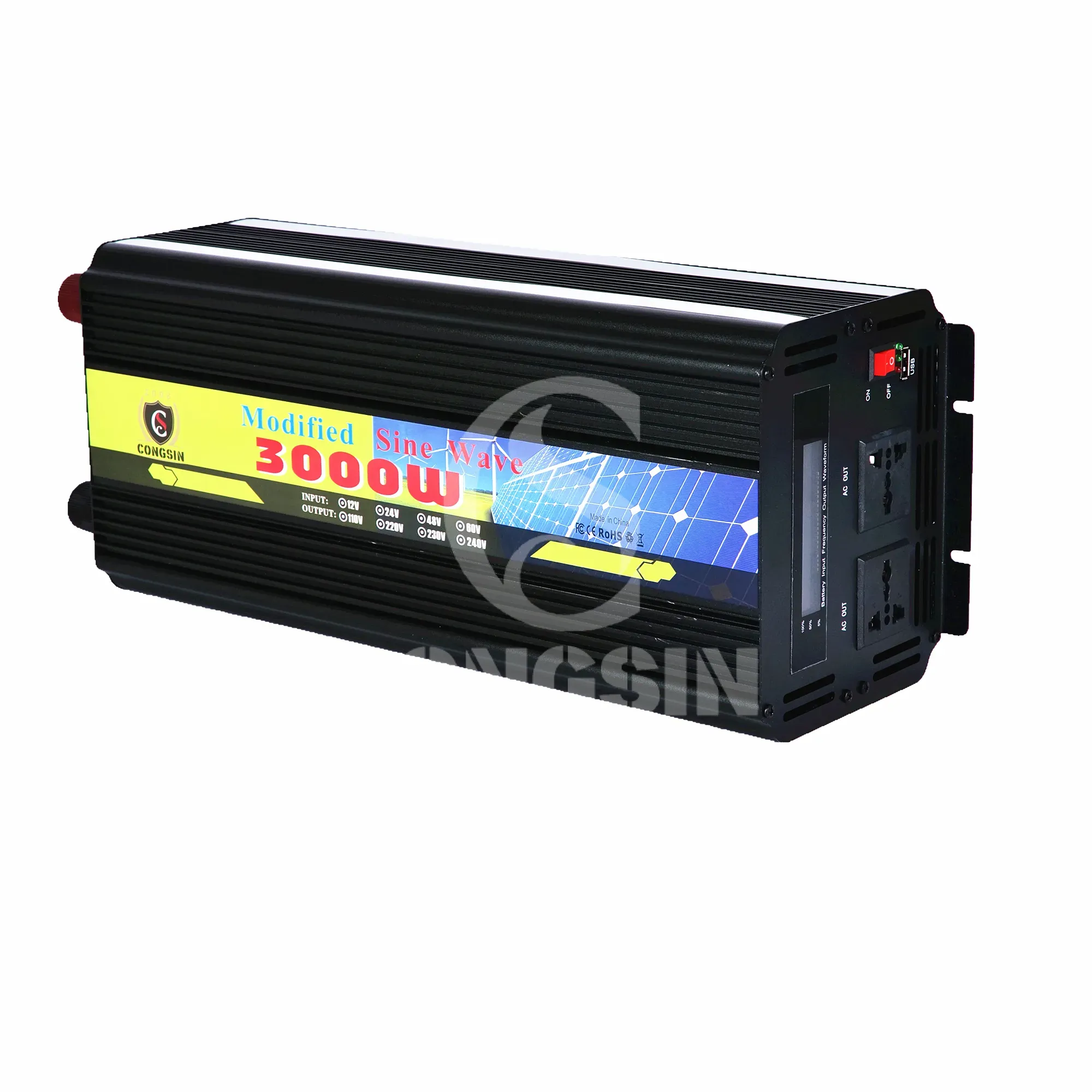
Congsin Full Power 3000W Modified Sine Wave Inverter Peak Power 6000W with LCD Display RV Solar
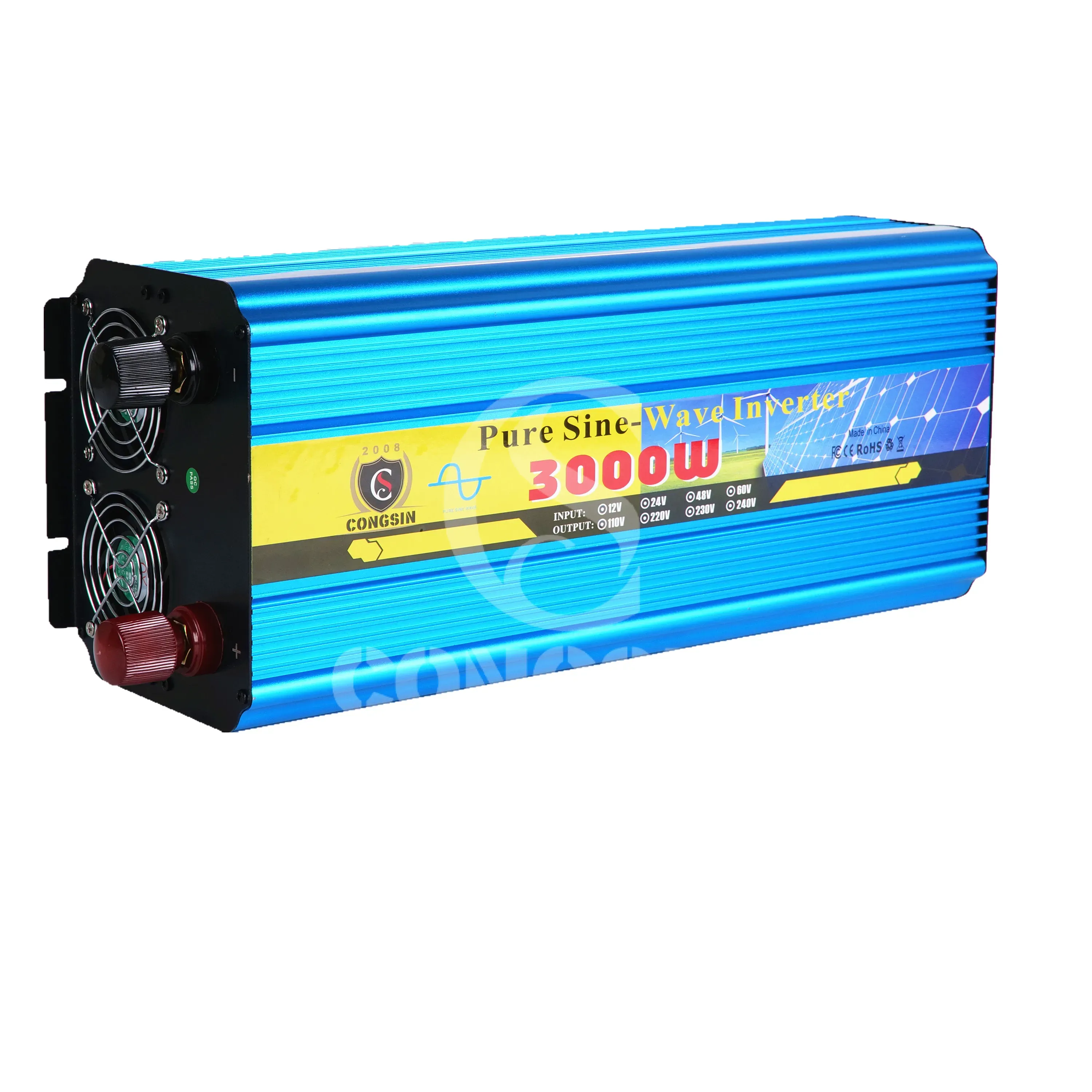
Congsin 3000W LCD Pure Sine Wave Inverter for Home Use Solar Backup Power Inverter Off Grid UPS
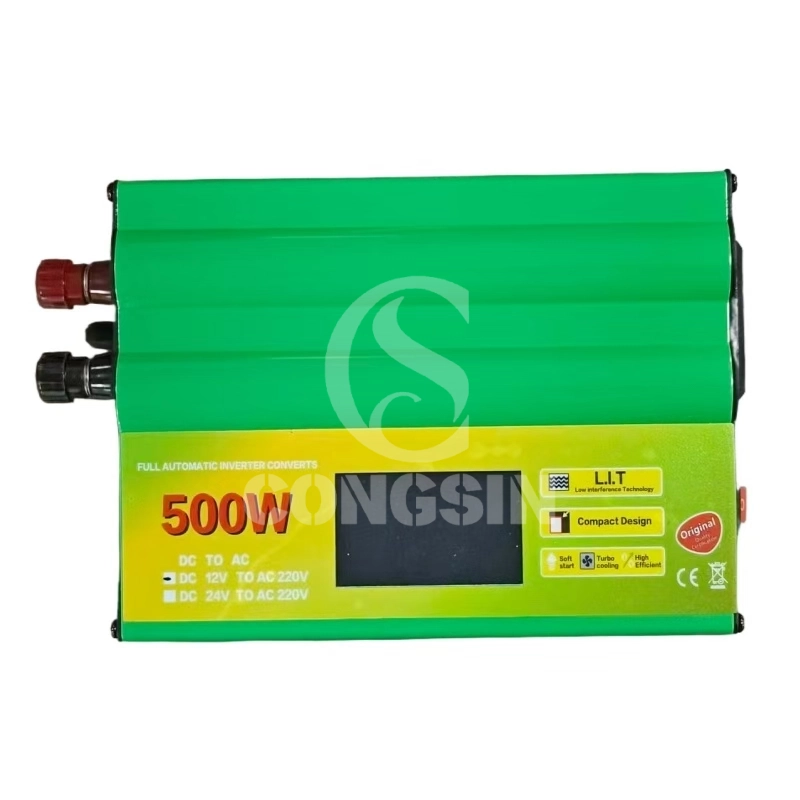
Congsin Modified Sine Wave Inverter 500W 1000W 1500W 12V LED Display Portable for RV Car Solar
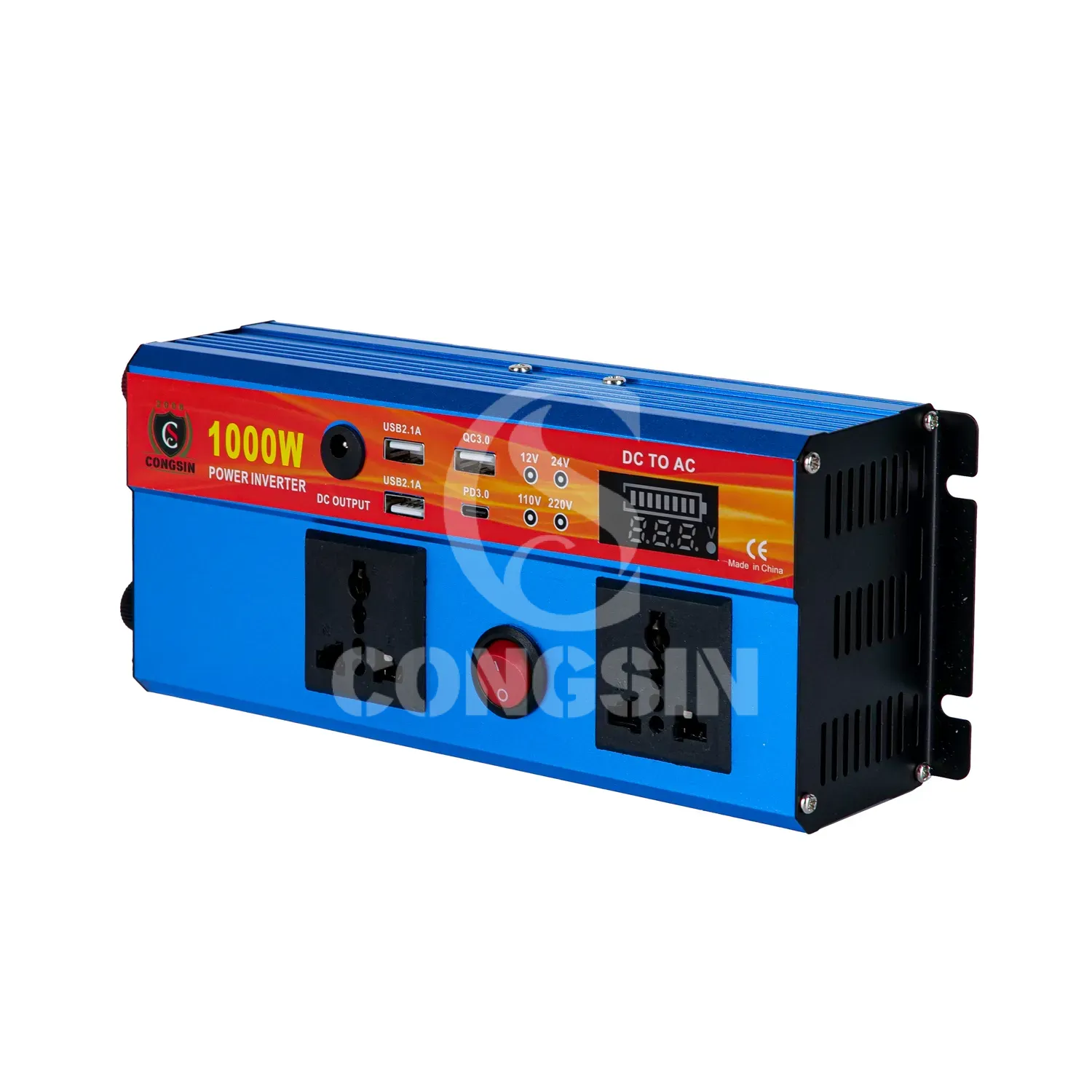
Congsin 1000W modified sine wave inverter with LED display and Type C port car RV power inverter

CONGSIN is a trusted OEM factory for power inverters, solar charge controllers, and DC converters. Reliable solutions for global B2B buyers.
 High Quality
 7/24 Service
 Guaranteed Warranty
© 2025 Congsin. All Rights Reserved.